NO LONGER NEEDED — WEB FUNNEL IS ACTIVE
Contact Marta for more info.
AM Hub
How to Transition Clients Away From the Website Funnel & Get Them Launched ASAP
The play is to transition people away from the Website Funnel to avoid further delays in rollout, and to launch clients as soon as possible. Frame the pivot as a data-backed executive upgrade, not a delivery failure. Primary recommendation is the B2B funnel. Backup option is cold email, LinkedIn, and warm network as a bridge if they insist on staying with low-ticket.
Full Playbook
Transitions Playbook — Internal Checklist & Line-by-Line Script
Complete reference doc with the full script, internal checklist and playbook.
Call Examples — Watch These First & Mirror Them
Study these recordings before running a transition call.
1. Purpose of the Call
Transition the client away from the original low-ticket/self-liquidating funnel and into the best available path forward.
The consultant's goal is not to "apologise and explain delays." The goal is to lead.
"We've reviewed the data, the funnel landscape, and your fastest path to revenue. Based on that, we believe there is a stronger and safer route forward for you."
This should feel like an executive strategy update, not a delivery excuse.
2. Core Positioning
"Originally, the plan was to launch you on the low-ticket self-liquidating funnel. That model is still valid, but based on what we are seeing right now, we believe the stronger move is to pivot you into a faster, more controllable funnel that gives us a clearer path to qualified sales conversations."
The client needs to feel three things:
- We are not abandoning the original plan randomly.
- We are making a data-backed strategic decision based on what is currently performing for us as a business and our top partners.
- The pivot benefits them because it gets them moving faster.
3. Call Opening
"Hey [Name], good to see you. The main purpose of today's call is to give you a strategic update on where we are taking the funnel from here.
I know the original direction was the low-ticket self-liquidating funnel, either the quiz-to-community version or the website funnel version. That model was designed to offset ad spend through low-ticket purchases, then move buyers into an onboarding call where you could upsell them with much less friction.
That logic still makes sense.
However, based on where we are right now, the fastest and safest move is to pivot you into a stronger route to booked calls and revenue."
4. Reassure the Client That DFY Still Means DFY
"At this level, you are on the done-for-you Inner Circle tier. That means we own the execution layer. Your job is not to become a media buyer, a funnel builder, or a technician.
Your job is to align with the strategy, show up to the right calls, and close the opportunities we create."
Mirror the strongest positioning from the call transcript: the client should "show up and close" while the company owns the execution layer.
5. Explain Why the Pivot Is Happening
"Here's the honest view. The original low-ticket funnel has more technical moving pieces. It requires more setup, more moving parts, and more infrastructure before we can launch it properly at the standard we want. Rather than letting that create drag, we are making the executive decision to move you into a funnel that is faster to deploy, easier to control, and more direct in terms of getting qualified conversations on your calendar."
Say
"There are some tech dependencies on the low-ticket funnel that make it slower than we want right now."
Don't say
"We failed to get the tech ready."
6. Primary Recommendation: B2B Funnel
"Based on your situation, the strongest move is to pivot you into the B2B funnel. The reason we like this path is simple: B2B gives us more control. We can target real businesses with actual budgets, real problems, and higher-value needs. Instead of trying to liquidate ad spend through $20, $50, or $100 purchases, we are optimising for qualified conversations with business owners who can afford a higher-ticket solution."
"This is a more direct path to revenue. It is cleaner, more targeted, and usually a straighter line to sales calls."
7. How the B2B Funnel Works
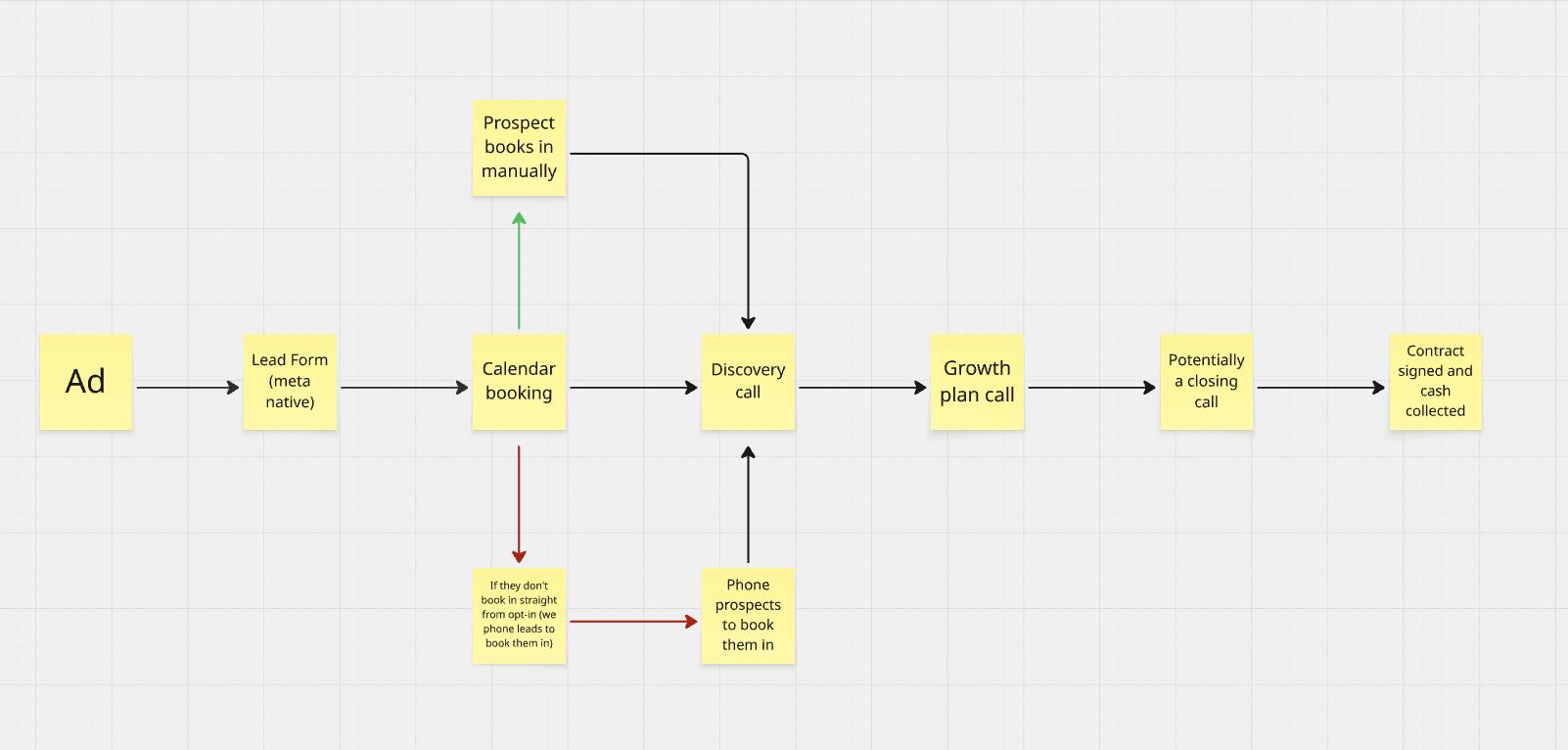
"The funnel is simple. We launch ads into a specific B2B niche. The prospect clicks the ad, fills out a lead form, and we qualify them based on key information like name, email, business type, and revenue. From there, the goal is to generate qualified appointments with businesses that actually have the ability to buy. We will own the ads, the creative, the copy, the targeting, and the launch process."
Share your screen and walk through the funnel overview:
8. The Commitment
"Our commitment is to fund and run the ads until we generate 10 qualified appointments for you."
"That gives us a clear target, a clear success metric, and a much better alignment between the strategy we are running and the outcome we are aiming for."
9. Niche Selection Talk Track
"From here, the first decision is niche. We are not asking you to marry this niche forever. We are picking the best starting point based on what we know is working right now. We will guide you using the niches we are seeing perform best, and then we will choose the one that gives you the strongest mix of market demand, buying power, and personal credibility."
If the client overthinks:
"Don't overthink this. This is an initiative, not a lifetime commitment. If the niche does not hit our internal markers, we can pivot again. The key thing is getting you live in the strongest direction now."
10. If the Client Asks: "Is This a New Program?"
"No, don't think of this as a new program. Think of this as us looking at the data, looking at the fastest path to revenue, and moving you into the funnel we believe gives you the safest and strongest chance of success right now."
11. If the Client Says: "But I Signed Up for the Low-Ticket Funnel"
"I completely understand that. The original low-ticket funnel was the plan, and the reason it was attractive is because it could offset ad spend through low-ticket purchases before moving people into an upsell conversation. The reason we are recommending this pivot is not because that logic is wrong. It is because right now, we believe this B2B path is faster, cleaner, and more controllable. We do not want you sitting around waiting for infrastructure when we can get you into market with a better immediate opportunity."
11b. Explaining "10 Paying Clients" → "10 Booked Calls" in the New Addendum
Clients will notice the guarantee language changed. This is the frame to explain why the fulfilment promise shifted with the funnel type.
"Good question. The original agreement referenced the low-ticket self-liquidating offer we had set up for you. The fulfilment for those 10 paying low-ticket customers was always going to be handled by us — triggered automatically whenever someone paid through the funnel at $20, $50 or $100. We serviced those low-ticket customers so you could confidently upgrade them to a high-ticket offer and fulfil on that separately.
Now that we're running the B2B funnel, it's a high-ticket approach instead. The customers you'll be closing and onboarding are paying $2,000 to $3,000. The offers our top partners at this Inner Circle tier sell are growth offers almost every time — increasing lead flow, generating booked appointments, and growing revenue. Those offers justify a high-ticket price, and they're straightforward to sell and to deliver.
Most of that delivery happens inside Acquisity in a couple of clicks, so we can support the fulfilment for these high-ticket clients directly. We'll go through it click by click together. Once you've closed that first deal and set up the client and their campaigns in about five minutes, we can also help you find, train and place a tech VA to own that process so it isn't reliant on you.
That's the optimal end-to-end model with the switch to a high-ticket funnel, and the best way for you to run the business as a CEO rather than being stuck in the weeds.
And to be clear, this is an addendum, not a new agreement. Things like the tech VA placement are still included — this just clarifies the fulfilment piece and the language around it."
- Low-ticket guarantee = 10 paying customers, because we fulfilled those $20–$100 buyers for them.
- B2B guarantee = 10 booked calls, because the end customer now pays $2,000–$3,000 and fulfilment is a growth offer delivered in Acquisity.
- They are not losing support — we walk them through delivery click by click, then help place a tech VA.
- It's an addendum, not a replacement agreement. Tech VA placement and existing entitlements remain.
12. [If Needed] Secondary Option: Bridge Strategy
Use only if the client strongly resists moving away from low-ticket.
"If you are absolutely set on staying aligned with the low-ticket funnel, we can use a bridge strategy. That means while the low-ticket funnel infrastructure is being finalised, we help you generate opportunities through cold email, LinkedIn outreach, and warm network activation. That gives you activity, conversations, and potential revenue now, rather than waiting passively."
13. Bridge Strategy Breakdown
- Cold email — cheap, scalable, targeted outreach.
- LinkedIn — build credibility, start conversations, connect with the exact market we want.
- Warm network activation — tap into people who already know you, trust you, or are one degree away from you.
This is not the primary recommendation, but it is a strong interim move if the client wants to keep low-ticket as the long-term path.
14. Objection Handling
"Why are we changing direction?"
Because we believe this gives you a faster and safer path to revenue. The original plan made sense, but based on the current data and deployment timeline, this is the stronger move.
"Did the original funnel fail?"
No. This is not about the funnel being invalid. It is about choosing the best path based on speed, control, and current execution reality.
"Am I losing what I paid for?"
No. You are still getting done-for-you execution. We are still owning the hard parts. We are simply moving that execution into the funnel we believe gives you the best chance of getting qualified opportunities faster.
"Can I still run the low-ticket funnel later?"
Yes. If that remains the right move, we can revisit it. But right now, the priority is getting you live and creating qualified sales opportunities.
"What do I need to do?"
Your role is simple: align on the niche, review anything we need you to review, and be ready to take the qualified appointments once they start coming through.
"What happens if the niche does not work?"
We monitor the data. If it does not hit the markers we need, we pivot. You are not locked into a bad direction.
15. Close the Call
"Based on everything we have covered, my recommendation is that we move forward with the B2B funnel. It gives us the best mix of speed, control, targeting, and revenue potential. From here, we will confirm the niche, build the ads, get the infrastructure aligned, and push this live as quickly as possible."
Then ask:
"Are you comfortable giving us the green light to move forward with this direction?"
16. After the Client Agrees
"Perfect. Then the next steps are simple. We are going to confirm the niche, build out the creative and copy, get the ads infrastructure ready, and launch this as the new primary funnel direction. You will not need to manage the technical pieces. We will own that. Your focus is going to be preparing for the conversations that come through."
Final Piece — New Contract
We have created new contracts to match the new funnel types. The client's Agreement must match their funnel — their strategy needs to match their contract.
Once you have converted them to either B2B funnel or cold email, you can send the new agreement in the Zoom chat while on the call and go through it there so they sign it OR you can prepare your client that they will receive it in their inbox as it will be automatically send when you track the transition (see below).
B2B Addendum — Sign LinkHow To Track Transitions
This is arguably the most important part of the process, and having good data discipline is a skillset that separates the good from the elite. To ensure we take no backward steps and keep the momentum that we've now developed, we need to make sure the tracking is robust at every single turn. There should never be a backlog. We should treat the tracking component as diligently as we treat the transitions themselves. This is non-negotiable.
Loom Walkthrough
How To Track Transitions